“Even before I come as a just judge, I come as the King of Mercy.”
– JESUS to St. Faustina Kowalska (1905–1938)
The following text was automatically translated using DeepL; we assume no responsibility for its (theological) accuracy.
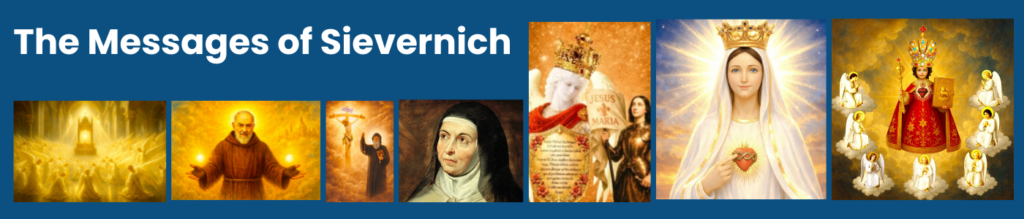
The first series of apparitions took place from 2000 to 2005. During this time, the Mother of God appeared as “Mary the Immaculate.”
Since 2018, the Lord has been appearing in the form of the Infant Jesus of Prague.
In addition, various saints play a role in Sievernich; see the respective menu items for details.
The messages are published here as follows (we have structured this website to mirror the layout of the books about Sievernich, in order to ensure a consistent reading experience):
- The words of the Lord in the form of the Infant Jesus of Prague, of Mary the Immaculate, and of the saints are printed in bold *
- Manuela’s own descriptions are in italics
- Any notes, courtesy of Dr. h.c. Michael Hesemann, are in regular type.
The messages are made available here to all interested parties for documentation purposes; their evaluation is the responsibility of the Roman Catholic Church. They are published without wishing to prejudge this evaluation. You can find more information about the guidelines for evaluating private revelations in German language ->here
Please note that neither the messages nor excerpts from them may be shared and/or published elsewhere without consulting Manuela.
*Almost all messages are dictated by the visionary in front of hundreds of eyewitnesses, recorded on tape, and announced immediately afterward at the prayer meetings in Sievernich. They are usually published on the website within 14 days. This rules out any possibility of subsequent tampering.
From the foreword to the book *King of Mercy*, with kind permission of the author, Dr. h.c. Michael Hesemann.
[…]
“Even though revelation was completed with the apostles, this must not be understood to mean that God—who warns us out of love—retired with the death of the Apostle John in Ephesus. Deists, Freemasons, and Protestants may believe in a ‘Deus emeritus,’ but we Catholics do not. Our God is a living God who takes an active interest in our fate and does not stand idly by while we rush toward our ruin. That is why, of course, even after the Revelation of St. John on Patmos, there were prophetic warnings—some through mystics and visionaries such as St. Bridget of Sweden or St. Catherine of Siena, who, after all, brought the Pope back from Avignon; St. Philip Neri; the Irish monk and saint Malachy; or, in our own time, St. Padre Pio of Pietrelcina. But also through Mary, the Queen of the Prophets (as the Litany of Loreto calls her), for example in the Church-recognized apparitions at Paris (rue de Bac) and La Salette, Fatima, Kibeho, or Akita. Since these “private revelations” were also initially viewed with skepticism or even opposed by official authorities before their authenticity became indisputable, we should at least consider the possibility that God still admonishes us today through prophets and prophetesses, apparitions, and mystical messages, and warns us against straying from the path. For only a God who is not indifferent to us is a living and loving God.
But this is precisely what prompts me to at least remain open to the messages from Sievernich. To be perfectly honest: I would be equally surprised and disappointed if Heaven were not to speak out in our age of godlessness, relativism, and the questioning of all morality and decency—and in the midst of the greatest crisis the Church has faced in its 2,000-year history. When the very foundations of the divine order of creation are called into question, when even bishops and cardinals seek to relativize—or even sanction—a mortal sin, when human beings place themselves above God and, on the basis of supposed “findings of the human sciences,” seek to rewrite the Catechism and the Church’s moral teaching—even going so far as to alter Sacred Scripture, including the “Lord’s Prayer,” this ipsissimum verbum (very own word) of Jesus—then there must simply be a response from God. It cannot be a coincidence that the first series of apparitions at Sievernich lasted from 2000 to 2005—that is, from the “Holy Year 2000” until the inauguration of Benedict XVI, when the German pope himself became God’s most prominent prophet and voice of warning against the spirit of the age. And that the second series began in 2018—exactly at the time when the madness emanating from Germany under the name “Synodal Path,” which threatens to plunge the Church into a schism and the greatest crisis of faith in its history, first took hold.
[…]
In retrospect, the timing of the resumption of the apparitions in November 2018 could hardly have been better chosen; it bears the hallmark of divine providence. The first apparition of the “new series” took place at a time when the world still seemed relatively orderly. Exactly 14 months later, COVID-19 first appeared in the news when the first cases were reported from Wuhan, China. After that, the world was a different place. First came (as precisely predicted in Sievernich) the “three difficult years” of the pandemic (in Germany from March 2020 to March 2023), then, in February 2022—announced ten months earlier in Sievernich—the war in Ukraine, with its devastating consequences not only for the people in the war zone but also for our energy supply and the world’s food supply.
[…]
Only the believer knows—and the messages from Sievernich assure him of this—that even in this time of tribulation, despair, and fear of the future, he is never alone. There is a loving God who desires our salvation, and we can encounter Him anew every day. We do not need apparitions or private revelations for this; for this, we have the sacraments. In another series of apparitions, in Garabandal in northern Spain between 1961 and 1965 (see Hesemann, Garabandal – Warnung und Wunder, Illertissen 2022), Conchita, one of the four child visionaries, said: “It is wonderful to have an apparition. It is even more beautiful to hear the voice of Jesus or the Blessed Virgin within oneself. But the very most beautiful thing is to receive the Lord within oneself in the form of the Eucharist.” In Sievernich, too, the Lord advises us to encounter Him regularly in the Eucharist, indeed to become “living tabernacles” (Message of May 25, 2023). If the messages succeed in inspiring us to live a life of faith, in fidelity to the Church, in humility, penance, and purity of heart, as well as to regularly receive the sacraments of Reconciliation and the Eucharist—if they guide us safely through the trials and tribulations of our time—then they have fulfilled their purpose. Anyone who now says, “We don’t need Sievernich for that—the Church has been teaching this since the days of the Apostles,” is, of course, absolutely right. But precisely because we are so quick to forget this, it is good and important to be reminded of what God wants from us and what the meaning and purpose of our lives is.”
[…]
Note: All messages are made public without intending to anticipate the judgment of
the Roman Catholic Church.